Tuff Shed Garage Conversion ADU: The San Francisco Owner’s Guide
When a Tuff Shed garage conversion ADU starts showing wear at the threshold, wall-to-floor connection, or roof flashing points, we stock and install Tuff Shed-compatible conversion components across San Francisco, with typical installed part replacements running $400 to $2,800 depending on what failed and how far the moisture or framing damage has traveled. Most owners discover the problem the way you just did: a soft spot near the door, a musty smell in the corner, or water staining where the Tuff Shed shell meets the new foundation work. Yes, we can usually address it same week, and if the part is on our truck (threshold plates, flashing kits, sill gaskets, anchor bolt assemblies), we can often do the swap in a single visit. Miles Hartwell has been doing ADU conversions on Bay Area lots for over a decade, and he’ll tell you straight: the Tuff Shed shell is a solid starting point, but the conversion joints are where San Francisco’s fog, salt air, and hillside drainage do their worst work.
Which Tuff Shed Models This Applies To
We work on the full Tuff Shed line used for garage and storage-to-ADU conversions: the Premier PRO Series, the Premier Ranch, and the barn-style structures that many San Francisco homeowners repurpose as accessory dwelling units. The compatibility questions come down to your wall stud spacing, floor joist direction, and whether your shed was factory-built with the standard 2×4 wall framing or upgraded to the taller eave height. The easiest way to identify what you have is to check the manufacturer’s label on the inside of the door jamb or the gable end: it lists the model code and build date. If that label is gone, measure the wall stud spacing. Premier PRO models run 16-inch on-center studs; some older Ranch models run 24-inch, which changes which threshold plates and sill anchors you can use without modifying the opening. For OEM vs aftermarket on Tuff Shed conversion parts, we usually recommend OEM for anything structural (anchor bolts, hold-down brackets, ridge beam connectors) and quality aftermarket for flashings and gaskets, where the material spec matters more than the brand stamp. We also stock conversion parts for Abodu, Cover, and Dvele models for owners comparing prefab options.
Signs Your Tuff Shed Garage Conversion ADU Is Failing
- Spongy floor near the entry door. This usually means the sill gasket beneath the Tuff Shed’s bottom plate has compressed or failed, letting moisture wick into the floor sheathing. We see this most in San Francisco’s Sunset and Richmond districts, where fog keeps things damp for months at a time.
- Visible daylight under the wall-to-floor junction. The Tuff Shed shell was built to sit on a wood or gravel pad, not necessarily a poured foundation. When it’s converted to living space on a new concrete slab, the transition joint is only as good as the flashing and sealant someone installed. If you can see light, water is already getting in.
- Corner gaps opened up after the first wet winter. Tuff Shed walls are built tight at the factory, but they’re not designed for San Francisco’s lateral movement on hillside lots. The corner trim and gable seams separate on steeper grades, and once they open, the wall insulation and interior drywall behind them start to fail.
- Musty odor localized to one wall cavity. That’s trapped moisture behind the vapor barrier. It typically traces back to a failed roof flashing at the eaves or a wall vent that was never properly flashed when the structure became living space. In a Tuff Shed conversion, the roof-to-wall flashing is often the original factory piece, and it was never intended to protect a conditioned interior.
- Door or window frames that no longer sit square. This signals slab settling or a foundation connection issue, not just an old part. On San Francisco’s fill-compacted lots, we routinely see Tuff Shed conversions where the original anchor points at the corners have pulled or corroded, letting the whole shell drift a quarter inch out of level.
Replacement Cost & What’s Included
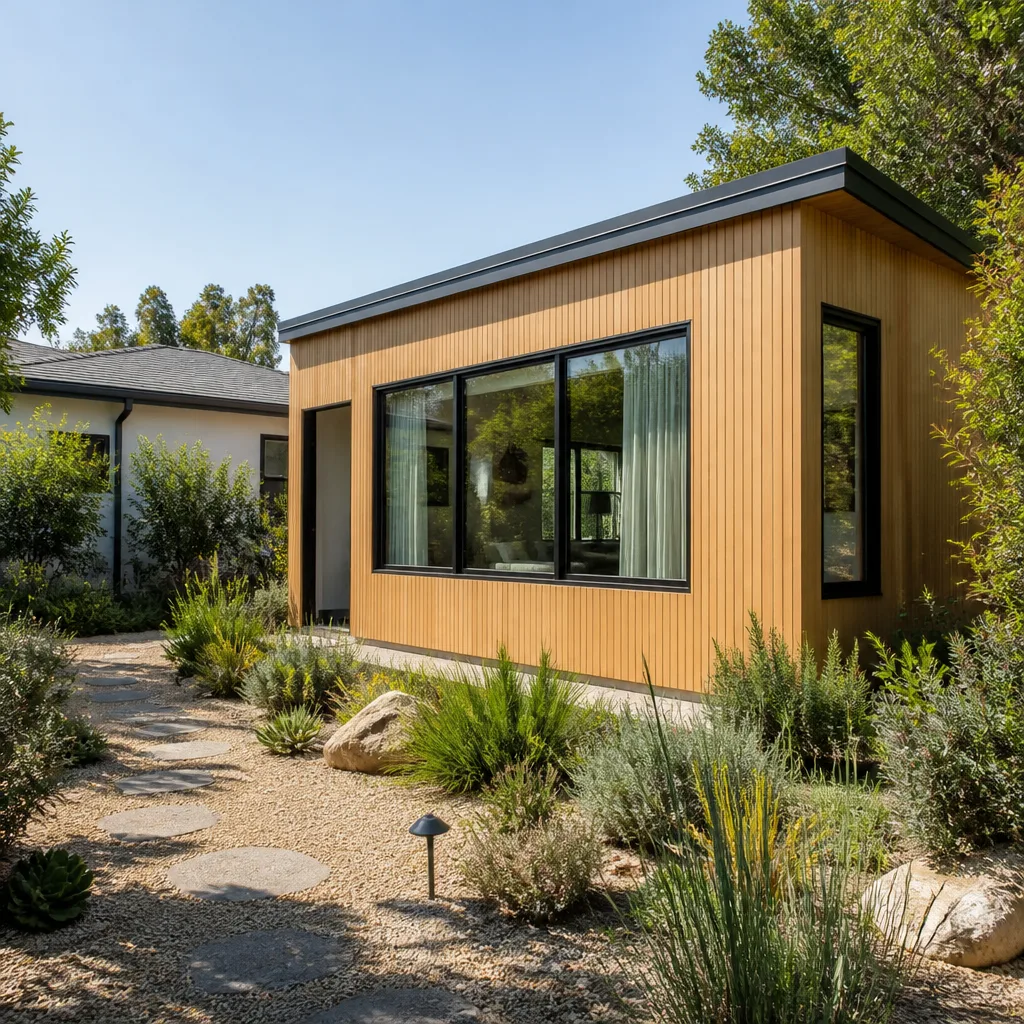
In San Francisco, plan on these installed ranges for common Tuff Shed conversion part replacements:
- Sill gasket and bottom plate repair: $400 – $900, depending on how many linear feet are involved and whether we’re pulling the wall siding to access the plate
- Roof-to-wall flashing replacement: $600 – $1,400, including removing the old flashing, installing new galvanized or stainless flashing, and resealing the seam
- Anchor bolt and hold-down retrofit: $900 – $2,100, including drilling and epoxying new anchor points into the existing slab if the original hardware has corroded or was undersized for the conversion
- Threshold and door-frame rebuild: $700 – $1,800, including pulling the door, rebuilding the rough opening with pressure-treated lumber, and reinstalling with new gaskets and flashing
- Full perimeter re-flash and reseal (all four walls): $1,800 – $2,800, when multiple seams have opened up and you’d rather solve it once than patch it corner by corner
Every quote is a written price before we start work, and it stays locked. That’s the Threshold Standard. The 365-Day Done Right Promise covers defects in workmanship for one full calendar year from project completion. If a part fails within that window, we return and make it right at no charge. That’s not a verbal promise; it’s written on the project document you sign before any tool gets lifted.
DIY or Call Us?
You can safely check a few things yourself: whether the sill gasket along the interior baseboard has gaps, whether the exterior trim screws have backed out, and whether you see rust staining around the original anchor washers. Those look-fors cost nothing and help us quote over the phone more accurately. What you should not do is attempt to lift a wall section, pull anchor bolts, or open up flood-damaged framing. A Tuff Shed shell under tension from slope movement or moisture expansion carries stored energy in its wall framing. Cut the wrong fastener and a corner can shift hard enough to pinch fingers or drop a wall panel onto you. We’ve also seen homeowners use the wrong sealant on Tuff Shed’s factory trim and trap moisture inside the wall cavity, making a $400 repair into a $2,000 one. If you’re not certain what you’re looking at, call (831) 272-7212 and we’ll talk it through. A straight answer now saves a painful conversation later.
FAQs
A properly installed threshold plate, flashing, and anchor set on a Tuff Shed conversion in San Francisco typically lasts 10 to 18 years, but the fog zones close to the ocean (Outer Sunset, Outer Richmond, Sea Cliff) cut that toward the lower end because of constant moisture and salt air on the flashing and fasteners. The factory shell itself, if kept painted and dry, can go 25 years. Call (831) 272-7212 for an exact assessment: we do a free visual inspection of all connection points and give you a written lifespan report for your specific structure.
Flashings and gaskets can usually be spot-repaired if the failure is caught early, within the first season of visible wear, but once water has migrated into the wall or floor framing you’re looking at replacement of the rotted section plus the part that failed. Anchor bolts and hold-downs are never repaired; they’re replaced as a set, because a partially corroded anchor is a false sense of security. Call (831) 272-7212 and we’ll tell you over the phone which situation you’re in based on what you describe and send someone if we need eyes on it.
Most single-part replacements on a Tuff Shed garage conversion ADU in San Francisco take one day, including the time to open the area, remove the failed part, install the new one, and reseal everything. Full perimeter re-flash and reseal jobs take two to three days. Weather matters: we won’t open your wall or roof in rain, and in San Francisco that means we schedule by the forecast, not the calendar. Call (831) 272-7212 for a time-of-year-specific answer for your neighborhood.
Yes. Our San Francisco trucks carry sill gaskets, threshold plates, anchor bolt kits, hold-down brackets, flashing rolls in galvanized and stainless steel, and the sealant systems rated for Tuff Shed’s factory trim and siding. For less common parts, like specific gable-end trim or door-opening kits for unusual model years, we order from our suppliers and typically install within four to six business days after the part arrives. Call (831) 272-7212 and give us your model code from the door jamb label, and we can tell you in one call whether it’s on the truck or needs to be ordered.
If your Tuff Shed garage conversion ADU is showing signs of the problems above, call (831) 272-7212 for a free estimate. We’ll send someone to look at the structure in person, write you a firm price before any work starts, and tell you exactly which parts make sense to replace now and which can wait a season. You’ll know the name and see the face of every person who comes to your property before they arrive. That’s the Sutton ADU San Francisco way, and it’s the only way we work.
Written by Miles Hartwell, Owner, Sutton ADU San Francisco at Sutton ADU San Francisco, serving San Francisco and nearby areas.