James Hardie Garage Conversion ADU: The San Francisco Owner’s Guide
If you’re converting a garage into an ADU in San Francisco and your exterior cladding or trim has failed, you’re likely looking at a James Hardie siding or trim replacement. In our experience, a partial siding repair on a garage conversion ADU in San Francisco typically runs $2,800 to $7,400 installed, depending on exposure, product line, and how much water got behind the old board. Most homeowners discover the problem after a winter storm, when paint starts bubbling near the bottom edge of the garage wall or a corner trim board swells and pulls away from the framing.
What makes James Hardie different from most siding is that it’s fiber cement, not wood or vinyl. It handles San Francisco’s fog, salt air, and wet winters better than almost anything else on the market, but it’s not indestructible. When installation details are wrong or flashing fails, even Hardie board absorbs water. And on garage conversions, we see the same failure pattern over and over: siding installed too close to grade, trim joints that were never flashed, and old garage slab edges that direct runoff straight into the bottom course of siding.
We’re Sutton ADU San Francisco, and we’ve been completing ADU projects across this city for well over a decade. We stock the most common James Hardie siding profiles, trim boards, and flashing components on our trucks, so most garage conversion repairs get diagnosed and priced in a single visit.
Which James Hardie Models This Applies To
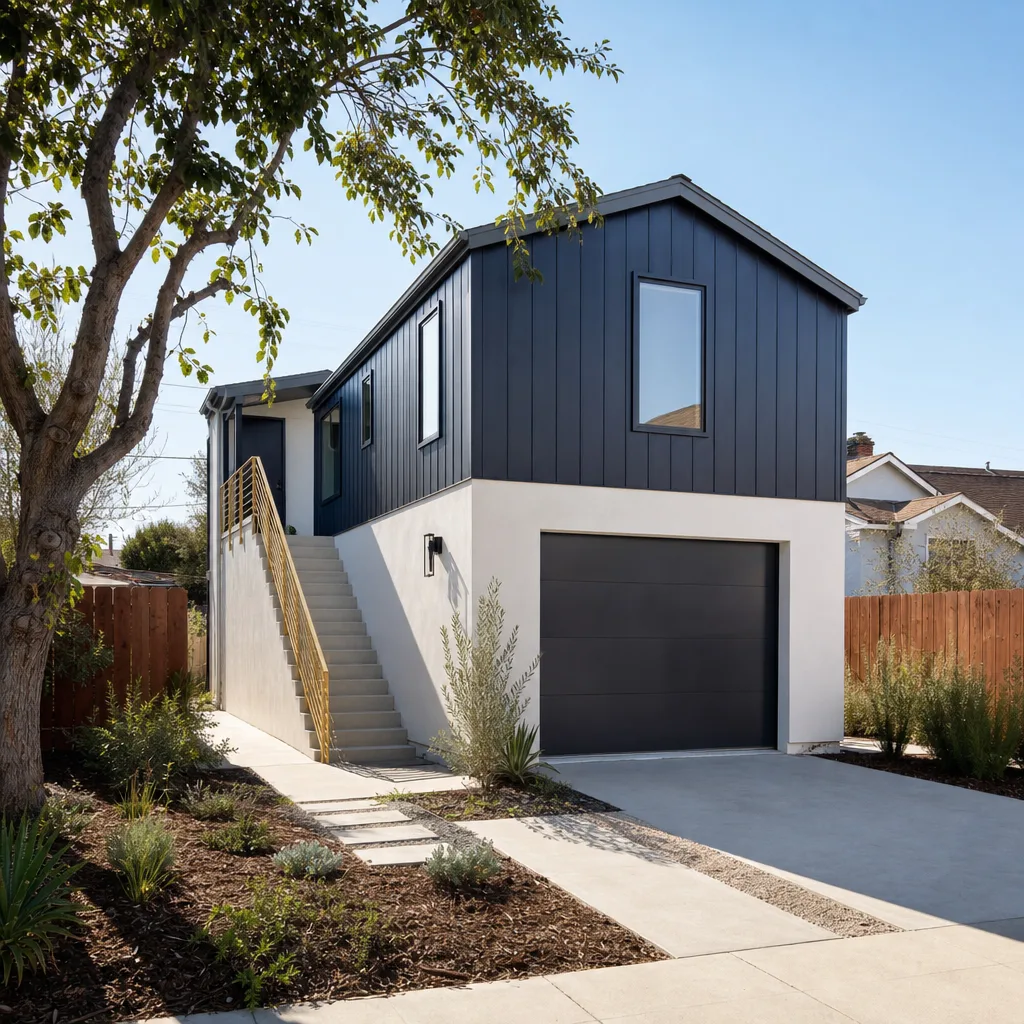
James Hardie makes several product lines, and the repair approach changes depending on which one your garage conversion ADU uses. The most common on San Francisco garage conversions is HardiePlank lap siding, typically in a 5/16-inch thickness, in either 6-1/4-inch or 8-1/4-inch exposure. Some older garage conversions used 4-inch exposure, which reads as a tighter, more traditional lap. We also see HardiePanel vertical siding on modern conversions, usually 4×8 or 4×10 sheets with a smooth or stucco texture.
For trim, HardieTrim boards come in 5/4 thickness (roughly 1 inch thick) and widths from 3-1/2 inches up to 11-1/4 inches. The boards you have will determine the repair cost, because wider HardieTrim is significantly more expensive per linear foot than narrow stock. One compatibility gotcha that catches owners off guard: James Hardie changed their color line in the 2010s, and certain older colors, like the original Timber Bark, no longer match the current product. If your garage conversion was built before 2015, a spot repair may require repainting the whole wall to blend, which we’ll flag before writing the quote.
James Hardie also has specific installation requirements that affect repair work. The siding must be installed with a 6-inch minimum clearance from grade, and butt joints between boards should never be caulked. On garage conversions, we frequently find the original installer missed one of these details, and that’s why the board failed in the first place. We install genuine James Hardie product for repairs, not aftermarket equivalents, because the warranty coverage and color-matching consistency are better enough to justify the small price difference.
One thing to be clear about: Sutton ADU San Francisco is an independent contractor. We’re not affiliated with James Hardie, and we don’t speak for their warranty department. We install their products, we stock their products, and we fix installations that other contractors got wrong.
What Fails First on a San Francisco Garage Conversion ADU
San Francisco’s climate is hard on exterior cladding. The marine layer pushes moisture into every gap from June through August, and winter storms drive rain sideways against west-facing garage walls. Here’s what we see fail most often on garage conversion ADUs in this city:
- The bottom course of siding near the garage slab. Water splashes up off the concrete or asphalt and seeps into the cut edge of the fiber cement. The paint blisters, the board softens, and eventually it crumbles at the corner. This is the single most common repair we do.
- Corner trim boards pulling away from the framing. HardieTrim is denser than wood trim and doesn’t flex much. When the backing framing shifts, which older San Francisco garages do constantly, the trim pulls nails or cracks. Torn or cracked trim lets water run behind the siding.
- Butt joints that were caulked at installation. James Hardie’s installation guide says not to caulk the vertical seams between siding boards, because caulking traps water instead of letting it drain. We see caulked joints on a huge number of garage conversions done by handyman crews. The telltale sign is a row of failing paint down every seam.
- Flashing failures around the garage door opening. When a garage door gets replaced during a conversion, the head flashing and jamb flashing often gets reused or left out entirely. Water runs down the wall and finds the gap. You’ll see staining or soft drywall on the inside along the top corners of the old garage door opening.
- Stucco texture panel delaminating near the ground. HardiePanel with a stucco texture can absorb water at the bottom edge if it was installed without the proper gap above grade. The texture layer starts to peel away from the substrate. Once it starts, it won’t stop until the panel gets replaced.
Replacement Cost & What’s Included
For a typical repair on a San Francisco garage conversion ADU, here’s what we tell people to budget:
| Repair Type | Typical Price Range (Installed) |
|---|---|
| Replace 5-10 linear feet of bottom-course HardiePlank siding | $900 – $2,100 |
| Replace one HardieTrim corner board with flashing correction | $700 – $1,500 |
| Replace full wall of siding on a single-car garage conversion | $3,500 – $6,800 |
| Replace full wall of siding on a two-car garage conversion | $5,200 – $9,500 |
| Replace damaged HardiePanel (single 4×8 sheet installed) | $800 – $1,900 |
Those numbers include the James Hardie product, paint-matched caulk, flashing, labor, and clean-up. The single biggest cost driver is how much water damage we find behind the board once it comes off. If the sheathing or a stud has started to rot, the repair expands, and we’ll show you what we found before any additional work starts. The price we quote in writing is the price you pay, unless we uncover hidden damage and clear the additional scope with you first.
Every repair is covered by the 365-Day Done Right Promise. If the work isn’t right within a full year of completion, we come back and make it right. No haggling, no invoice.
DIY or Call Us?
You can check a few things yourself without much risk: look at the paint condition near the bottom edge of the garage wall, see if any trim boards are pulling away from the corners, and check inside the wall along the old garage door opening for water stains. Those observations help us diagnose the problem faster when you call.
What you shouldn’t do is pull off a damaged board to see what’s behind it. Fiber cement siding that’s water-damaged tends to crumble when you try to remove it, and if there’s live wiring or plumbing behind that wall, you can create a much bigger problem than the one you started with. Cutting James Hardie siding also requires the right saw blade and dust control; the silica dust from cutting fiber cement is a respiratory hazard. A straight answer now saves a painful conversation later. If the board is damaged, call us at (831) 272-7212 and we’ll send a technician with the correct product on the truck, a written price before any work begins, and a photo badge you can verify at the door.
FAQs
James Hardie siding carries a 30-year limited warranty, and in San Francisco’s climate we typically see the product hold up for 20 to 35 years before failing, depending on installation quality and exposure. Installations with proper clearance above grade and correct flashing commonly last 30-plus years. Installations that ignored those details can show damage within 5 years. Call (831) 272-7212 if you suspect your siding was installed without proper clearance, and we’ll assess it.
In most cases, yes. We can remove the damaged boards, replace the flashing, and install new James Hardie product that matches the existing profile and paint color. If the color line has been discontinued, we’ll tell you before writing the quote so you can decide whether spot-repainting or a full-wall repaint makes more sense. Estimates are free.
Most single-wall repairs on a San Francisco garage conversion take one full day, including removal, flashing correction, new product installation, and paint matching. Larger jobs or repairs that uncover framing damage can run two to three days. We’ll give you a firm timeline when we write the estimate.
We keep the most common HardiePlank profiles, HardiePanel sheets, and HardieTrim boards on our trucks, along with the correct flashing components. If your garage conversion uses an uncommon profile or color, we can typically source it from a Bay Area supplier within a few days. Call (831) 272-7212 and we’ll confirm what we have before we schedule the visit.
If your James Hardie garage conversion ADU is showing signs of siding or trim failure, call Sutton ADU San Francisco at (831) 272-7212. We’ll give you a straight answer on what’s wrong, what it costs to fix, and exactly who will be showing up at your door to do the work.
Written by Miles Hartwell, Owner, Sutton ADU San Francisco at Sutton ADU San Francisco, serving San Francisco and nearby areas.