James Hardie New Detached ADU: The San Francisco Owner’s Guide
If you’re planning or already own a detached ADU clad in James Hardie siding or panel systems in San Francisco, the parts that fail most often aren’t the Hardie boards themselves, they’re the trim, flashing, and fastening components that hold the system together. We stock and install James Hardie-compatible trim boards, corner pieces, starter strips, and flashing specific to detached ADU builds, and most replacement jobs run between $450 and $2,400 depending on what’s deteriorated and how much of the cladding has to come off to reach it. You’ll usually know something’s wrong when you spot cracked trim at the bottom edge of your ADU, paint peeling at a joint, or a soft spot where the siding meets the foundation after a wet San Francisco winter.
Here’s the unglamorous truth about James Hardie products on a detached ADU in San Francisco: the HardiePlank and HardiePanel boards themselves hold up remarkably well for decades, but the corners, the trim around windows and doors, and the flashing behind them take the real beating from fog, salt air, and the constant damp of the Sunset, Richmond, and Outer Mission neighborhoods. We’ve been working these lots long enough to know that when a homeowner calls about “failed Hardie siding,” nine times out of ten it’s actually a failed transition, not a failed board. This page walks you through exactly what fails, what it costs to fix in San Francisco, and how to know whether you’re dealing with a simple trim replacement or something that needs a builder’s eye.
Which James Hardie Models This Applies To
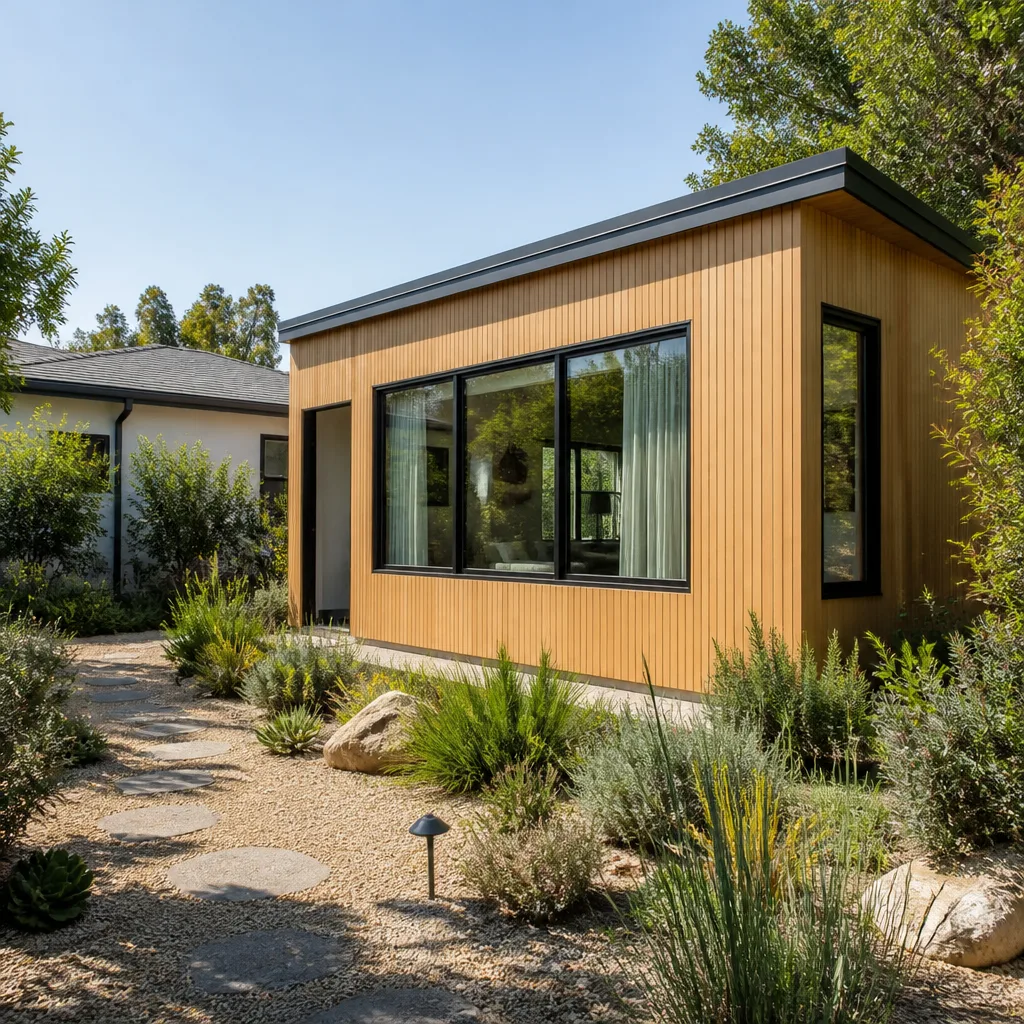
The parts we’re talking about here fit the James Hardie product lines most commonly spec’d on detached ADUs in San Francisco: HardiePlank lap siding (the horizontal boards), HardiePanel vertical siding (the 4×8 and 4×10 sheets), and HardieTrim boards used at corners, windows, doors, and the transition where the ADU wall meets the roof eave. If your ADU was built in the last 15 years, there’s a strong chance the original contractor used HardiePlank lap siding in the 5.25-inch or 7.25-inch exposure, with either the standard 3/8-inch thickness or the thicker 7/16-inch boards needed for San Francisco’s wind exposure requirements on exposed lots.
Here’s a compatibility gotcha most homeowners don’t know until it’s too late: HardieTrim comes in two very different products that look almost identical on the wall. The smooth-faced HardieTrim boards (like the 4/4 and 5/4 thickness pieces) are not interchangeable with the wood-grain-textured boards in terms of expansion gap and fastening pattern. If a previous owner or a handyman patched a corner with the wrong profile, the joints open up within a couple of seasons because the materials expand and contract at slightly different rates. When we come out for an estimate, we check the back of a removed piece or the exposed factory edge for the product code, usually stamped near one end. OEM James Hardie trim runs about $2.75 to $4.25 per linear foot in the Bay Area, and quality aftermarket trim (from companies like CertainTeed or Nichiha) can save you 20 to 30 percent, but we generally stick with OEM on San Francisco ADUs because the warranty on the board only applies when you use Hardie’s own fasteners and flashing system. Sutton ADU San Francisco is an independent contractor, not affiliated with James Hardie, but we’ve installed and repaired enough of these systems to tell you when OEM matters and when it’s just a brand premium.
Signs Your James Hardie New Detached ADU Is Failing
- Bottom-edge cracking at the weep screed line. This is the most common failure we see on San Francisco ADUs, especially in the fog belt west of Twin Peaks. The HardieTrim board at the base of a wall sits too close to grade or gets repeatedly splashed by rain, absorbs moisture through a hairline crack, and then the wet-dry cycle of our climate opens it further each season.
- Peeling paint specifically at corner joints and window trim. James Hardie products don’t peel on their own, but paint failures at joints usually mean the original installer butted trim pieces too tightly together. Hardie requires a 1/8-inch gap at all trim-to-trim joints to allow for expansion; without it, the boards press against each other, crack the paint film, and expose raw material.
- Soft or spongy areas near the foundation sill. This is the sign to take seriously. If a HardiePanel or lap board at the bottom 12 inches of the wall feels soft when you press it, the moisture barrier behind it has likely failed, and you’re now dealing with water intrusion, not just a cosmetic part swap.
- Visible rust marks running from fastener heads. Hardie requires corrosion-resistant fasteners (hot-dipped galvanized or stainless), but many San Francisco ADUs were built with the wrong nails, and the fog near Ocean Beach or Lake Merced accelerates corrosion fast. Rust stains are the visual cue that the nail heads are failing inside the board.
- Gaps opening between trim and the window or door frames. When you can see daylight or a widening gap around window openings, the caulk joint has failed and the trim board behind it is likely swelling. This gets worse quickly in San Francisco’s damp winters, and it’s rarely a two-day fix once the board has moved.
Replacement Cost & What’s Included
In San Francisco, you should expect to pay between $450 and $900 for a straightforward trim board replacement (one corner, one window surround, or a short run of starter strip), including the matching Hardie part, proper color-matched fasteners, flashing, and sealant. A full trim package replacement on a typical 400 to 600-square-foot detached ADU, which includes all corners, all window and door surrounds, and the eave-to-wall transition, runs $1,800 to $3,400. All these figures include the labor to cut out the failed pieces, inspect the moisture barrier behind them, and install new components to James Hardie’s published specs. We give you a written price before any work begins, so if the number changes, you’ll hear about it before we pick up a tool, not after.
What drives the range? Access is the big one. A detached ADU in Inner Richmond where the failing corner is at ground level with clear ladder access is a different job than in a Glen Park hillside lot where the upper trim requires scaffolding and a spotter. Materials for a Hardie trim replacement are usually only 25 to 35 percent of the total cost; the rest is the controlled removal (so we don’t damage the board above), moisture inspection, and the precise reinstallation that keeps the warranty valid. Every Sutton ADU San Francisco project carries the 365-Day Done Right Promise, which covers defects in workmanship for one full calendar year from project completion, and the written price you approve is the written price you pay.
DIY or Call Us?
There’s a narrow window where DIY makes sense on James Hardie trim, and a wide window where it goes wrong quickly. You can safely remove a small loose section of trim to see what’s behind it, and you can reseal a hairline crack with an elastomeric caulk as a stopgap while you get estimates. What you shouldn’t do is cut corners off a wall and replace them yourself unless you’ve worked with fiber cement before. Hardie board requires a diamond-tipped or carbide blade (not a wood blade), specific gapping, and the correct fasteners, and the dust from cutting it is a silica hazard that requires a dust mask, not a bandana. We’ve repaired enough DIY Hardie work on San Francisco ADUs to say this plainly: the materials are not forgiving, and a bad trim job usually means water gets behind the board, which turns a $600 repair into a multi-thousand-dollar wall repair. If you’re uncertain about what you’re seeing, call (831) 272-7212 and describe it. We’ll tell you over the phone whether it’s something you can safely patch or something that needs a builder’s hands.
FAQs
Properly installed HardieTrim and HardiePlank should last 25 to 30 years in San Francisco’s climate, but the corner and window trim typically needs replacement at the 15 to 20-year mark because it takes more water exposure than the field boards.
If your ADU is 15 years old or older and you’re seeing multiple failed trim pieces, call (831) 272-7212 for an honest assessment, estimates are free.
Small hairline cracks can be sealed with a high-quality elastomeric caulk and repainted for a temporary fix, but any crack wider than 1/16 inch or any board that has swelled or warped needs replacement, not repair. Sealing a structural crack traps moisture behind the board and makes the next failure worse.
A single corner or window surround replacement takes half a day to a full day including sealant cure time; a full trim package on a 500-square-foot ADU takes two to three working days. Weather in San Francisco rarely delays Hardie work the way it does painting, because we can install in dry, overcast conditions as long as no actual rain is falling.
We keep standard 5/4 HardieTrim boards, starter strips, corner pieces, and flashing in stock for common San Francisco ADU applications, and we can source any unusual profile from local suppliers within one to two days. The part that makes the difference is the flashing, not the board, and we always carry the correct widths for San Francisco’s damp-climate installation standards. Call (831) 272-7212 with your ADU’s rough dimensions and we’ll confirm stock before you commit to anything.
If you own a detached ADU in San Francisco and you’re seeing failing trim, cracking corners, or water stains on your James Hardie cladding, call Sutton ADU San Francisco at (831) 272-7212 for a free estimate. We’ll send you the name and photo of the technician before anyone arrives, hand you a written price before the first board comes off, and stand behind the work with the 365-Day Done Right Promise. A straight answer now saves a painful conversation later.
Written by Miles Hartwell, Owner, Sutton ADU San Francisco at Sutton ADU San Francisco, serving San Francisco and nearby areas.